
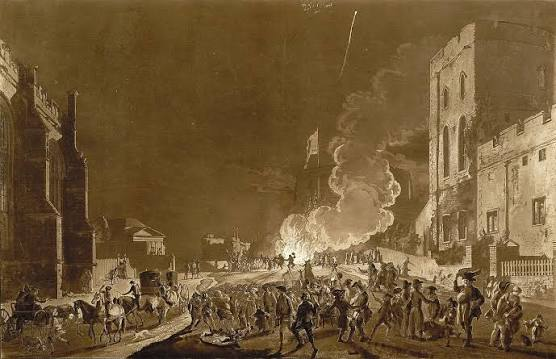
Every November, families across Britain gather around bonfires, watch the fireworks illuminate the sky and enjoy the traditional activities which have bee handed down from generation to generation.
For many people, Bonfire Night is just a chance to spend the evening together as a family. Yet have you ever stopped to wonder where your family’s traditions began?
Perhaps your grandparents prepared a special dish every 5 November, your family gathered on the same village green each year, or an old photograph captures relatives enjoying a bonfire decades ago.
These small details can reveal more about our ancestors than might expect, and in November we will be looking at how ordinary traditions, family memories and historical records can help you discover the stories associated with your family tree.
The Traditions That Connect Generations
We often continue family traditions without giving them much thought. Whether it’s preparing a familiar recipe, celebrating a special occasion or sharing stories, these customs become part of our family identity.
Some may have originated with grandparents or great-grandparents. Others could have been brought to Britain by relatives who moved from another country, adapted to changing circumstances or introduced customs from their own childhoods.
Something as simple as a family celebration, a favourite recipe or an annual gathering might offer clues about how your ancestors lived.
Consider the traditions that you still observe nowadays. Do you know who was the one who originated them? Have these traditions always been celebrated in the same manner? Might they have a connection with a place which your ancestors once called home?
Putting these questions to yourself can turn ordinary family traditions into a chance to examine your heritage.
Looking Beyond the Family Stories
One of the most rewarding parts of researching family history is discovering that the stories passed down through generations are sometimes only part of the picture.
It is possible that a grandparent could remember that an ancestor moved away in order to look for work. A relative might be able to recall a family name which no one nowadays appears to recognise. Maybe you’ve heard some stories concerning a distant relative who went abroad but never found out what actually happened to them.
These memories are a useful starting point, but historical records can help you investigate the stories further and separate family recollections from documented evidence.
Depending on the period and circumstances, useful records might include:
- Census records: Discover where your ancestors lived, who shared their household and what occupations they held.
- Parish registers: Explore baptisms, marriages and burials to help establish family connections.
- Newspaper archives: Search for local events, community celebrations and significant occasions involving your relatives. Wills and probate records: Uncover potential family connections and find out who inherited an estate.
- Photographs and personal letters: Look for clues about family relationships, important events and places your relatives lived.
Each record gives a different point of view and, when taken together, a number of sources can contribute to forming a better understanding of the ancestor’s life.
What Old Photographs Can Tell Us
An old family photograph can be more than a keepsake; it can also provide valuable clues for your family-history research.
You might possess a photograph of relatives celebrating a festival, standing outside the former family home or attending an event where no one knows who exactly the guests are.
Begin by examining the details carefully. Is there anything written on the back in the way of a date? Can the location be identified? Are there any signs, buildings or other features which might indicate where the photograph was taken?
Clothing, hairstyles and the people pictured together can all offer useful clues. However, these details should be treated as starting points rather than definite proof.
If you have any older relatives who might be able to identify the people in a photograph, it would be a good idea to ask them before those memories are lost, since they might recall the names, the relationships or the stories which would otherwise be hard to recover.
It would also be a good idea to make digital copies of significant photographs and to store them in a safe place. Whenever possible, include the names, dates and locations so that future generations can understand what they are looking at.
What appears to be an ordinary photograph today may well prove to be a very valuable link to the past for someone who is researching your family many years from now.
Finding the People Behind the Records
It’s not just a matter of gathering names and dates; genealogy involves coming to an understanding of the people who came before us and of the lives they lived.
Records can tell us where an ancestor was born, when they married or what occupation they held. But as your research progresses, you may uncover surprising details about their lives.
An ancestor’s change of address might suggest they moved for work. A probate record could reveal previously unknown relatives, while an unfamiliar surname in a marriage register might lead you to an entirely new branch of your family tree.
It is not true that all discoveries will be dramatic or that every question will have its answer right away. Furthermore, some records might be missing, hard to read or conflicting.
That’s why it’s important to consult a variety of sources rather than relying on a single document or one family member’s account.
Constructing a trustworthy family history requires patience, careful research, and a readiness to follow the evidence no matter where it takes you.
At Family Wise Ltd, we know that every family has a unique story, and even the smallest discovery can make a difference.
Preserving Your Family History for the Future
Discovering your family history is only part of the journey; preserving what you find is just as important.
Family memories can easily be lost over time. Names are forgotten, photographs lose their context, and stories that once seemed familiar become harder to piece together.
There are a number of simple methods that can be used to help prevent this.
- Ask older relatives about their childhoods, their parents and grandparents, and the family traditions they remember growing up with.
- Write down family stories. If you have their consent, record their conversations or make audio recordings so that they may relive their memories.
- Sort your photographs and label the pictures with names, approximate dates and locations if you can.
- Prepare a family tree by gathering together the names, the relationships and the key dates in one place so that the connections become easier to understand.
- Safeguard important documents by carefully storing the original records and making digital copies when you can.
It is not necessary to investigate hundreds of years of history at once; simply recording the story of one family or identifying a person’s face in an old photograph is a valuable thing to do.
The kind of information you save now may help future generations to understand their own origins.
Your Family’s Story Is Worth Discovering
Bonfire Night reminds us how traditions can bring people together across generations. Family history does something similar, connecting us with the people and stories that came before us.
Under every surname, photograph, and historical document there is a person whose life has played a part in the family’s history.
In some cases the story is well recorded, in others a bit more investigation is needed in order to bring it to light.
You may already possess all that you need to start investigating your heritage; an old photograph, a remark by a relative or a name noted in the margin of a family Bible could all serve as the beginning of something more extensive.
If you’ve reached a dead end in your research, you don’t have to work through the unanswered questions alone.
At Family Wise Limited we assist people in discovering their family histories, in looking into family connections and in exploring the stories that have been lost over time. If you are just starting your research or if you are trying to solve a long-standing mystery, our team will help you take the next step.
This 5th of November, as you’re appreciating the fireworks and carrying out the family customs, why not stop for a moment to consider the generations who came before you?
Your family history consists not merely of a list of names and dates but is a story which is worth keeping.
If you want to know how we can assist you in finding yours, you can go to Family Wise Limited or get in touch with our team at info@family-wise.co.uk.
