
In historical records, a name can be the difference between discovering an entire family history and reaching a dead end. Yet, hidden among the birth and death registers of England and Wales and thousands of entries where a name should be, but isn’t. Instead there is a blank space, a dash or a single work: ‘Unknown’.
These records relate to people whose identities, origins or family connections were never established. Some were babies abandoned shortly after birth. Others were adults who died without anyone coming forward to identify them.
The word ‘foundling’ is often associated with Victorian workhouses, orphanages and the pages of Dickensian novels. But the history of unidentified people extends much further. The absence of a name in an official record is not simply a historical curiosity. It represents a real person whose story may have been lost, sometimes leaving unanswered questions for generations to come.
Understanding these records helps us appreciate both the challenges of historical genealogy and the importance of preserving the information that connects people to their families and origins.
The Foundling Hospital and the beginnings of organised care
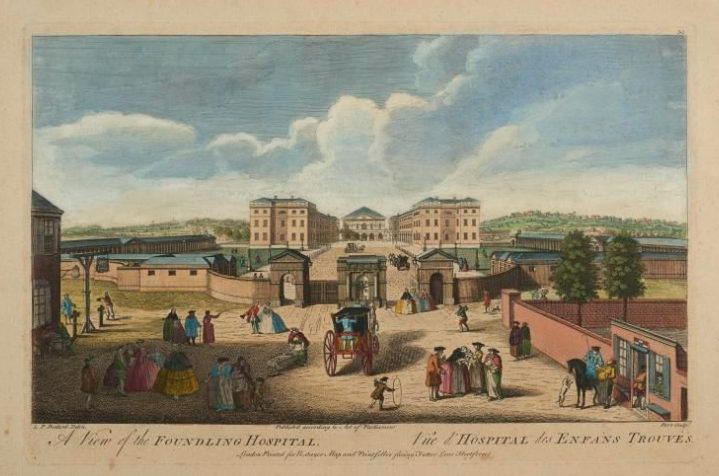
The history of organised care for abandoned children in Britain can be traced back to one man’s determination to do something about the number of babies being abandoned on the streets of London.
In 1739, retired sea captain and philanthropist Thomas Coram obtained a royal charter to establish the Foundlings Hospital. It became the first institution in Britain specifically dedicated to caring for abandoned children.
At the time, poverty and the social stigma surrounding unmarried motherhood meant that many women felt unable to raise their children. The Foundling Hospital offered alternative, although demand was initially so great that a lottery system had to be introduced to determine which babies could be admitted.
Children accepted into the Hospital were given new names, and their previous identities were often lost within the institution’s records. Some mothers left small personal objects, known as tokens, with their babies. These might be coins, pieces of fabric or even verses cut in half. The intention was that the objects could later help establish a child’s identity if the mother returned.
Many never did.
Some of these tokens have survived and are preserved as important pieces of British social history. They are a poignant reminder that, behind every unidentified child, there was a mother, a family and a story that may never have been fully recovered.
The organisation continues today as Coram, having developed into a charity working across adoption, fostering, family support, education and children’s rights. Although its work has changed considerably since the eighteenth century, its founding principle remains relevant: a child’s future should not be determined by whether their origins are known.
What does ‘unknown’ actually mean in a historical register?
To most people, a birth or death certificate is simply an administrative document containing names, dates, places and other personal details.
For genealogists, however, these documents are often the starting point of an investigation. A single entry can lead to marriages, census records, relatives and entire family trees.
But what happens when the most important information is missing?
An entry marked ‘Unknown’ can present a significant challenge. Without a confirmed name, parents or family details, it may be difficult to connect the individual to other historical documents.
In some cases, other information may still be available. A location, approximate age, occupation or the circumstances surrounding a birth or death can provide valuable clues.
However, these details do not always lead to a definite identification.
The difficulty is that historical records were created for administrative purposes, not necessarily to help future generations reconstruct family histories. Where information was unavailable at the time, it may never have been recorded.
For anyone researching their ancestry, this can mean reaching a point where the usual methods of tracing family connections are no longer enough.
The Abandoned Children Register: An issue that never disappeared
The history of abandoned children did not end with the Foundling Hospital.
In England and Wales, the Abandoned Children Register was introduced in 1977 and continues to receive entries.
Before its introduction, a child’s birth could be recorded in the ordinary birth registers, with details of unidentified parents left blank or recorded as unknown. The information available might be limited to the date and place where the child was discovered, alongside any other details that could be established.
For the individual concerned, this could mean growing up with little or no information about their biological family.
For genealogists, it creates a very different research challenge from tracing an ordinary family tree.
Instead of following a chain of names, marriages and birth registrations, the investigation may have to begin with a single document containing very few identifiable details.
Across generations, these missing pieces of information have left people with unanswered questions about where they came from.
The personal impact of not knowing
It is easy to view records relating to unidentified people as historical curiosities, particularly when they date back more than a century.
But not knowing one’s biological parents or family origins is not simply a historical issue.
For some adults who were abandoned as infants, adopted or brought up without access to their birth family information, the absence of that knowledge can remain significant throughout their lives.
Questions about medical history, ancestry, heritage and identity may remain unanswered. For some, the uncertainty becomes part of everyday life. For others, it can become an ongoing search for information that was never available to them in the first place.
There is no single way of experiencing this situation, and not everyone wishes to search for their biological relatives. Equally, finding an answer is not always possible.
The consequences can also extend beyond the individual whose details are missing. When someone disappears from the historical record without being identified, relatives and descendants may never discover what happened to them.
Unknown identities therefore create gaps in family history in more than one way: people who do not know where they came from, and families who may never have known what happened to someone they lost.
Can modern genealogy and DNA testing help?
Fortunately, the opportunities available to people researching unknown parentage have changed considerably.
Historical genealogical research, combined with modern DNA testing, can sometimes reveal connections that would previously have been almost impossible to establish.
DNA matches may identify previously unknown relatives, while traditional research can help build family trees and establish possible relationships.
For adoptees and people whose birth parents are unidentified, this can provide a starting point for discovering biological family connections.
The process is not always straightforward. Records may be missing, DNA matches may be distant, and some family connections may be difficult to establish.
In certain cases, a search may not produce a definite answer.
It is important to recognise that every person’s circumstances are different. Some people want to discover their birth parents, others are interested in understanding their wider ancestry, and some simply want to know more about the circumstances surrounding their birth. Whatever the motivation, sensitive and professional support can make an enormous difference.
Why the history of foundlings still matters
The history of the Foundling Hospital is often treated as a story that belongs entirely to the eighteenth century: an institution was established, abandoned children were given somewhere to go, and the problem became part of the past.
But the wider history tells us something different.
The difficulties surrounding unknown identities, missing family information and unanswered questions about biological origins have not disappeared.
Historical registers demonstrate how easily a person’s identity can become lost when the information needed to establish it was never recorded or has not survived.
The Foundling Hospital’s original mission also raises a question that remains relevant today: what responsibility does society have towards children and individuals whose origins cannot be traced?
Coram continues to address this through its work in adoption, fostering, family support and children’s rights.
For those whose official records still contain the word ‘Unknown’, the importance of that work has not diminished.
A missing name does not mean that a person’s story has no value. Nor does it necessarily mean that the story cannot be continued. Sometimes, the answers are still waiting to be discovered.
Searching for answers of your own?
If you have ever looked at a birth certificate, adoption record or family tree and found a missing name, an unexplained gap or the word ‘Unknown’, you may be wondering where to begin.
These are precisely the kinds of challenges that professional genealogists work with.
Researching unknown identities requires a different approach from building a conventional family tree. It may involve examining historical birth and death registrations, adoption records, newspaper reports, institutional archives and other surviving documents.
Where appropriate, DNA testing can provide additional opportunities to identify biological relatives and establish family connections.
At Family Wise Ltd, our UK-based team of professional genealogists and people finders specialises in tracing family histories, interpreting DNA test results and helping adoptees and individuals with unknown parentage locate their biological relatives.
Whether you are just beginning to ask questions about your origins or have been searching for years without success, we understand that every case is different.
You do not have to navigate complicated historical records or uncertain family connections alone.
Contact Family Wise Ltd to discuss your circumstances and discover how we may be able to help you take the next step towards finding the answers you have been looking for.
